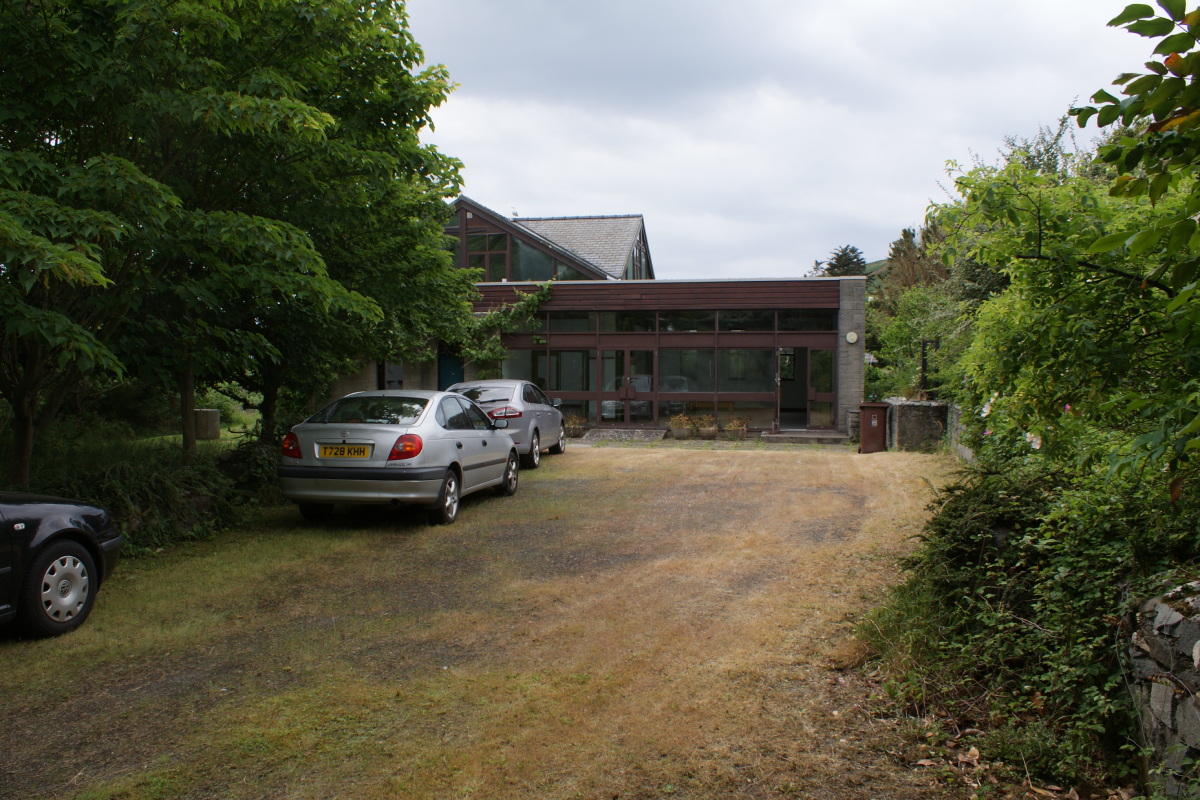
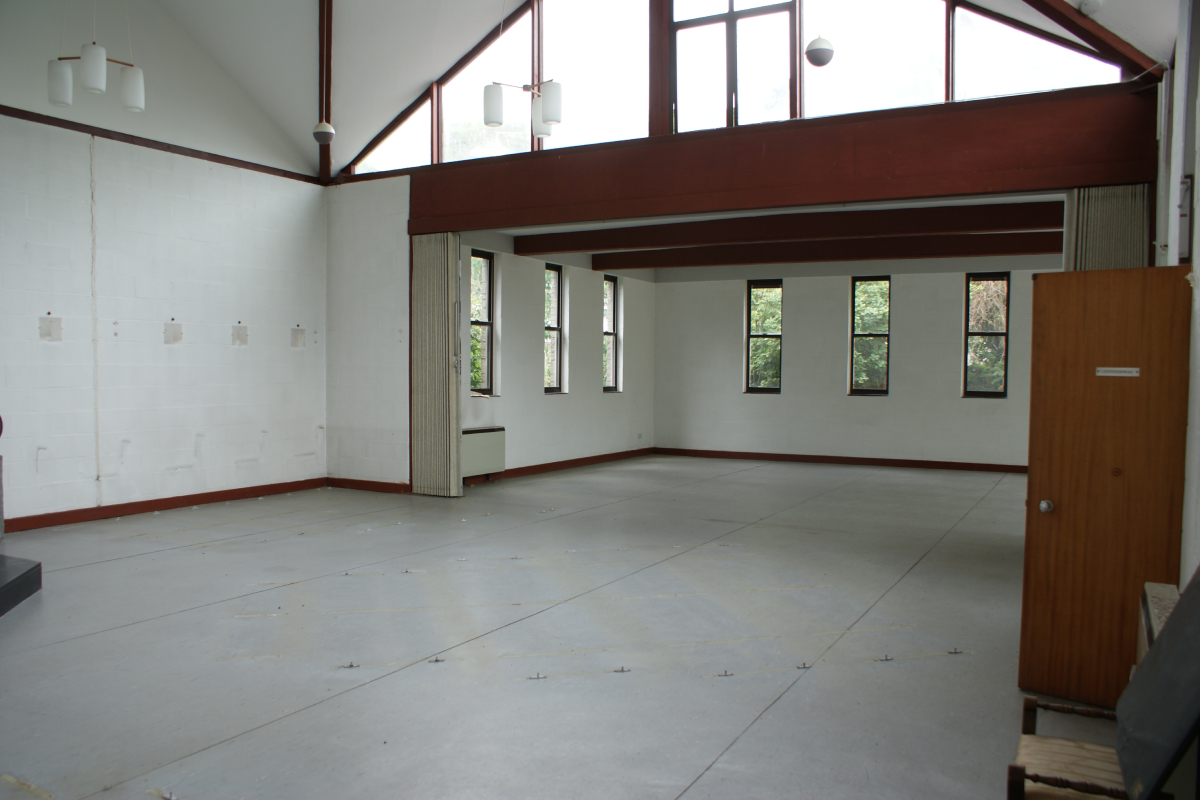
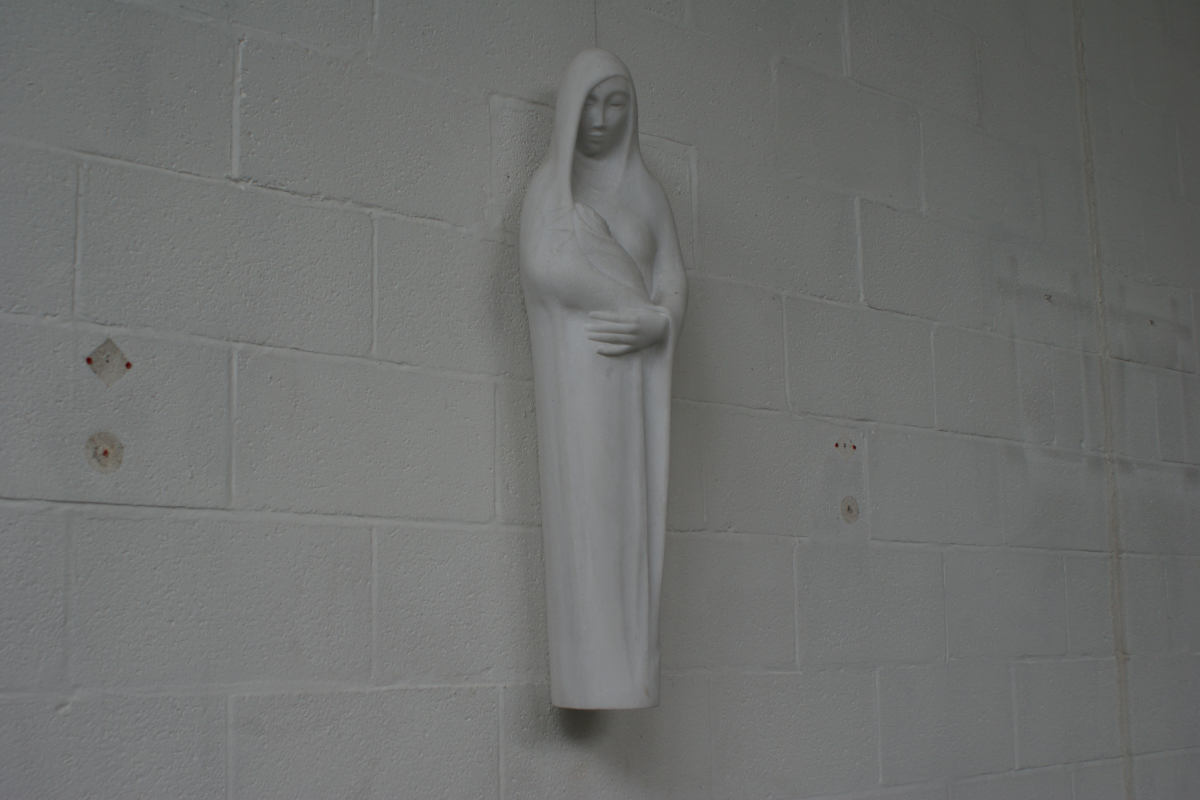
A modern, functional design of the mid 1970s, built to accommodate increasing numbers during the holiday season. Internal planning was designed to meet modern liturgical requirements, with seating arranged on a fan-shaped plan around the sanctuary to one corner. At the time of writing (June 2018) the building was no longer used for worship, and had been emptied of most of its furnishings (although a marble statue of the Virgin and Child by John Skelton remained).
The first Catholic presence in Aberdyfi came just before the outset of the First World War, when the Jesuits hired the Aberdovey Hotel during the summer months as a holiday residence for their novices. In the years after the war a small community of Catholics developed as workers moved into the town. By 1931 the community was substantial enough for a priest to travel from Aberystwyth to say a regular Mass in a dance hall over the Market Hall. In 1937 Colonel Ruck and his wife (who was Catholic) provided a room at their home ‘Bryndeno’ for use as a Mass centre; the house was at the top of Vicarage Hill.
In 1939 the Rev. Basil Rowlands moved to Aberdyfi from Machynlleth for three months, staying at ‘Hendrie’, the home of Mr and Mrs Charles Wright. Originally from Wolverhampton, the Wrights were both Catholics and in the early 1940 gave their tin hut garage for use as a Mass centre. The hut had been in use at Park Hall Camp, Oswestry, a military training camp, during the First World War. It had a pitched roof, with cardboard lined walls and ceiling and held approximately forty people. The site had formerly been used as a paddock and was surrounded by a small wood, which became known as ‘Catholic Wood’. Griffith Evans, a local builder, transformed the hut into a chapel, including construction of the altar, communion rails and sacristy furnishings.
During the 1960s the Rev. Charles Lloyd was appointed priest at Aberdyfi, and he endeavoured to improve the tin chapel. With the help of locally-based soldiers he cleared some of the trees from the site and in 1965 the chapel was renovated and extended. A single transept was added, making it L-shaped and increasing the capacity to about one hundred.
By 1972 it was evident the building was no longer fit for purpose and the community set about fundraising for a new church, for which plans were prepared by the Liverpool firm of Weightman & Bullen (who had earlier produced the designs for St David, Tywyn, for Fr Lloyd, qv). In 1974 the old tin chapel was demolished and building of the new church began on the same site. The church of Christ the King opened at Easter 1975 and was consecrated later that year, on the Feast of Christ the King.
In 2015 regular Sunday Mass ceased after the retirement of the parish priest, and in August 2016 the church was closed as a result of diocesan pastoral review. At the time of visiting (June 2018) the future of the building was uncertain.
Description
The church was constructed in 1974-75 to the design of Weightman & Bullen, architects of numerous churches in the diocese between the 1950s and 1970s. Modern in design, the building is a steel frame construction with concrete block walls and pilasters faced externally with random courses of artificial stone. The roof is largely flat with a cross-gabled semi-glazed roof over the nave and sanctuary. The windows are metal framed with clear glass.
The interior consists of a wide entrance space, hall and nave with adjacent confessional, sacristy and WC. Designed as a multipurpose space, the nave, hall and entrance were separated by sliding partitions, to allow for larger congregations during the summer months. The nave though square on plan had seating arranged in a fan shape towards the corner sanctuary. The flooring throughout is grey vinyl, the walls painted white, and the steel roof beams clad with timber. One partition is painted timber and glazed while the other is aluminium and vinyl. The holy water stoup is of carved, black polished slate; the altar has a black polished slate mensa on a rectangular, hammer dressed granite block matching the font, which has a slanted rim with a carved inscription ‘Baptizari in nomine Domini et Ivssit Eos’. A wall-mounted Carrara marble statue of Our Lady with the Holy Infant is by John Skelton, nephew and apprentice of Eric Gill.
Text amended by AHP 4.12.2025
Architect: Weightman & Bullen
Original Date: 1975
Conservation Area: No
Listed Grade: Not Listed