Sutton Road, Seaford, East Sussex BN25 1SS
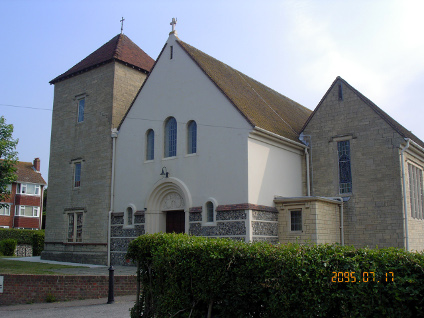
An attractive but architecturally unremarkable building, notable for the involvement of the artist and liturgist Geoffrey Webb. Stained glass by Webb remains, but his baldacchino over the high altar was removed in a post-Vatican II reordering.
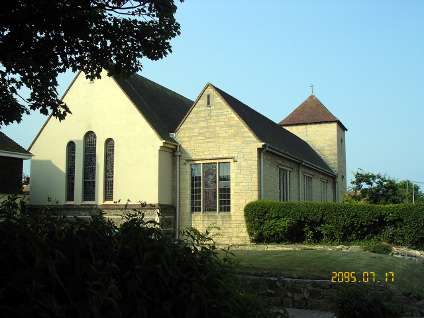
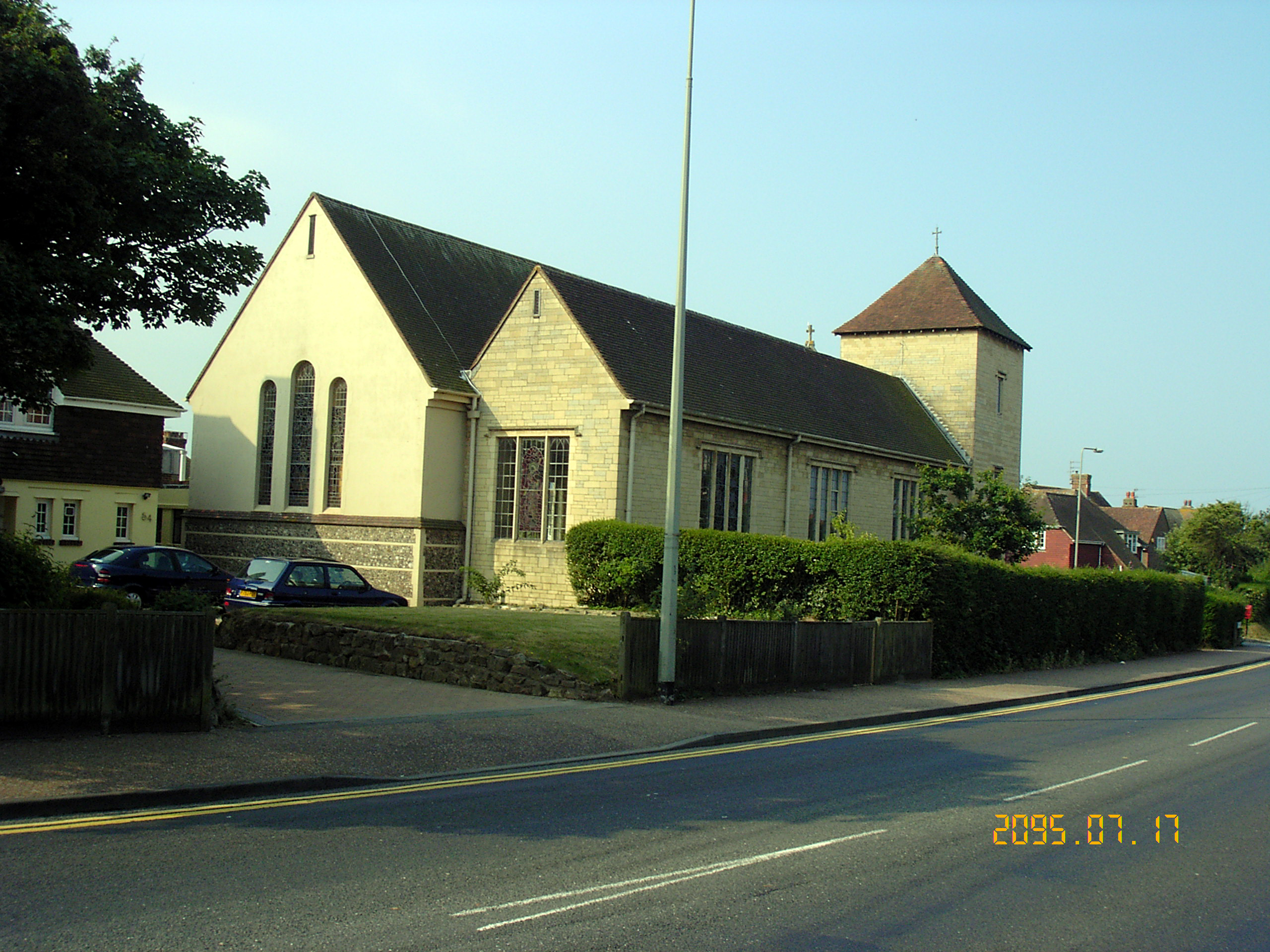
The original part of the church, dedicated to the newly-canonised St Thomas More, was opened by Bishop Amigo of Southwark in March 1936. This part can clearly be seen as the simple rectangle that forms the nave and sanctuary, together with part of the south aisle. This is rendered externally (apart from some flintwork at the west end) and has plain round-arched windows. The architect was James O’Hanlon Hughes (1894-1967), in collaboration with the Catholic artist and liturgist Geoffrey Webb (1879-1954). Hughes was born in Glasgow and was in private practice in London from 1918-1940 and was with the Office of Public Works in Dublin from 1940-1956. As well as working as an architect he published two volumes of poetry. Webb (nephew of the architect Sir Aston Webb) was apprenticed to the stained glass artist C.E. Kempe and is perhaps best known as author of The Liturgical Altar (1933); at Seaford, he designed a barrel vaulted canopy supported by columns to go over the high altar.
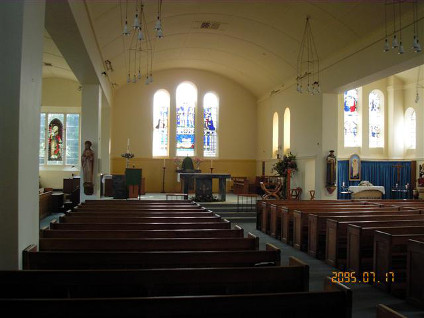
In 1969 the church was aggrandised by H. Bingham Towner with the addition of a gabled north aisle and northwest tower with pyramid roof and an extension to the south aisle. Towner’s work is executed in irregularly coursed reconstituted stone and has flat-headed domestic style windows with stone mullions. Inside, Towner removed the nave walls, opening up as far as possible into a single space.
The three-light east window with Crucifixion and saints and martyrs (including St Thomas More) is by Webb (1935). After the regrettable removal of Webb’s high altar and baldacchino in a post-Vatican II reordering, the window was enlarged, with lower panels added by Cox & Barnard (1980), including an image of the Tower of London. There are two further windows by Webb in the south aisle, erected in 1946 in gratitude for deliverance in the Second World War. The north aisle east window is by W.T. Morris and was brought here from Christ Church, Newhaven (demolished in 1965). The south aisle west window also came from Christ Church. A window in the north chapel is by Murphy Devitt of Dublin (1971). The Stations of the Cross are oil paintings on canvas. A parish hall is attached to the southeast, 1984 by Anthony Whitty.
Amended by AHP 29.10.2026
Architect: J. O’Hanlon Hughes and G. Webb; H. Bingham Towner
Original Date: 1935
Conservation Area: No
Listed Grade: Not Listed