Duncan Terrace, Islington, London N1
Elena Curti
Elena Curti
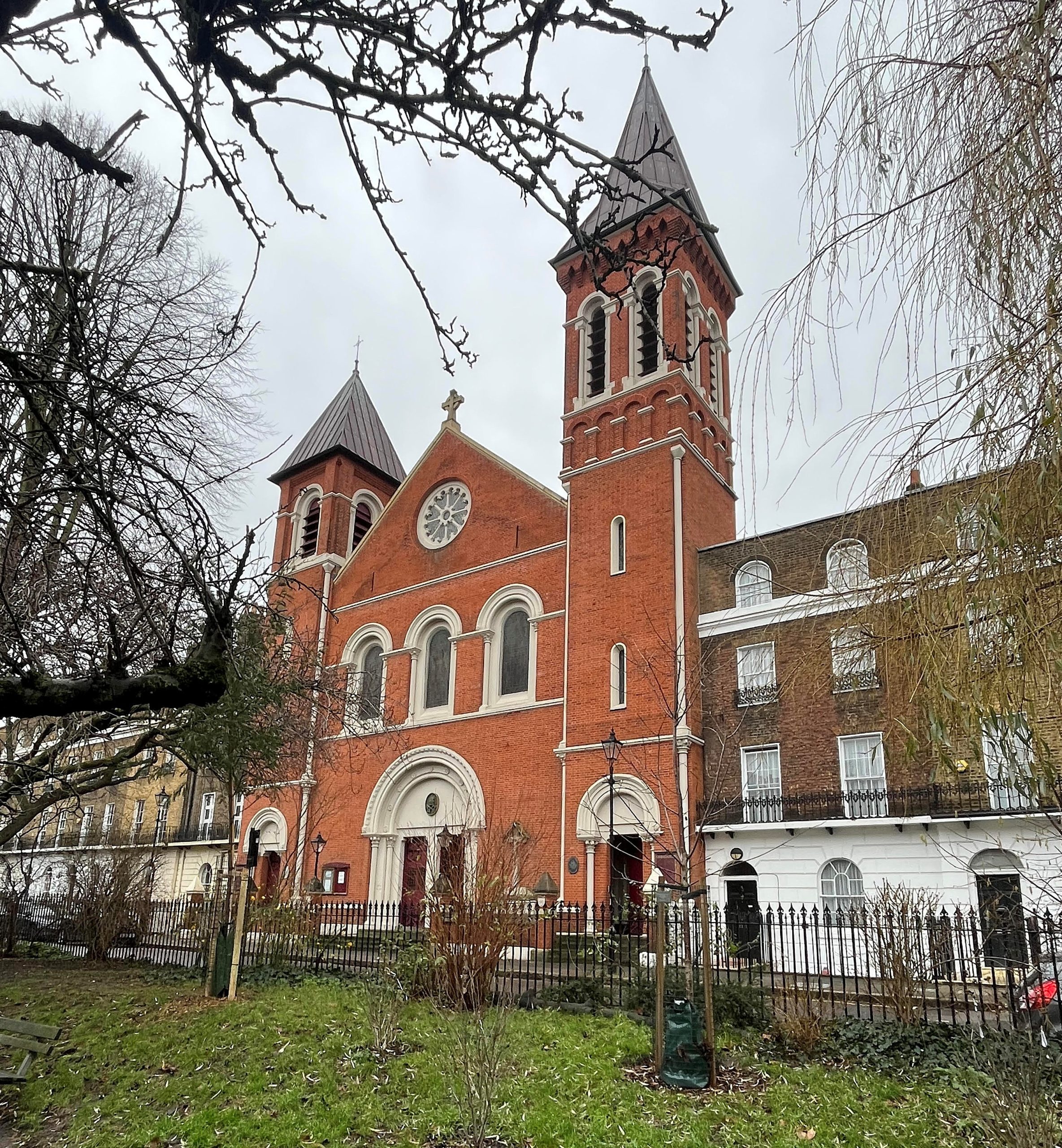
A neo-Romanesque brick church built in the 1840s from designs by J. J. Scoles. The asymmetrical towers on the main frontage were completed in the 1870s by George Goldie. The chief furnishings are now in the side chapels, and include paintings by Edward Armitage RA amongst others. The church is flanked by contemporary London stock brick terraces, which include the presbytery and convent. It is a significant landmark in the local conservation area.
The mission was founded from St Mary Moorfields and a plot acquired in Duncan Terrace (then being developed). In 1839 a dual purpose school-chapel by J.J. Scoles was erected. This was succeeded by the present neo-Romanesque church, also designed by Scoles, the foundation stone of which was blessed by Bishop Thomas Griffiths, Vicar Apostolic of the London District, on 27 September 1841. Bishop Griffiths returned to open the church on 26 June 1843, on which occasion Bishop Nicholas Wiseman preached. The builder was Mr Tiernan of Somers Town. The semi-dome of the apse was painted by Agostino Aglio, who twenty years earlier had painted the dramatic Crucifixion scene at St Mary Moorfields. A.W.N. Pugin castigated Scoles’s design as ‘the most original combination of modern deformity that has been executed for some time past’, but the building was defended by Joseph Hansom in the pages of The Builder. At the time of the opening Scoles’s west gallery and the two west towers remained unfinished, although a bell cast by the Whitechapel Bell Foundry was blessed in 1843 and placed in one of the stumps. Galleries were built in the first and fourth arches at the rear and at the front of the church on the north side (now boarded over).
Between 1850 until his death in 1880, the rector was the Rev Canon Frederick Oakeley, who had converted in Oxford about the same time as John Henry Newman and Frederick William Faber. Like them, he was a noted hymnodist, perhaps now best known for translating Adeste Fideles (Oh Come, All Ye Faithful). As well as establishing St John’s as a centre of excellence in music and liturgy, he oversaw much of the enrichment of the interior – he later wrote that the church at the time of his arrival ‘wore the appearance of a barn’ (The Tablet, 14 December 1872). In 1850 Oakeley had gas lighting installed and began the enrichment of the interior. The Lady Chapel, St Francis Chapel and Blessed Sacrament Chapel (now Sacred Heart Chapel) were all developed between 1850 and 1852, when Cardinal Wiseman (now Archbishop of Westminster) opened the Blessed Sacrament Chapel. In 1852 an organ built by J.C. Bishop & Son was added off the right hand side of the sanctuary (later enlarged by Bishop, Starr & Richardson). The Blessed Sacrament Chapel was repainted by H.T. Bulmer in 1855, and in 1859, Edward Armitage RA provided painted decoration in the St Francis Chapel. Armitage then added painted scenes of Christ and the Apostles as part of the enrichment of the sanctuary, inspired by San Clemente in Rome and including a new high altar based on that at the (first) Passionist church in Highgate. Cardinal Wiseman returned to open the completed sanctuary in August 1862. In 1872, an altar and tabernacle designed by George Goldie of Goldie & Child and made by Thomas Earp was installed in the Blessed Sacrament Chapel. The church was consecrated on 26 June 1873. Completion of the towers took place in 1877, from designs by Goldie: ‘Working upon the basis provided in the original design of the church by the late Mr Scoles, the architect, and carrying out the Norman or Byzantine style, Mr Goldie has produced a characteristic grouping of the two towers, which differ in design and elevation, and save the façade from monotony and common-place. The whole front has been repaired and cleaned down, and nothing is wanting to its perfection but the sculpture – now left in rough stone – of the tympana of the three doorways’ (The Tablet, 27 October 1877). (The tympana remain plain, apart from a small carved medallion above the central doors.)
Further enrichment took place under Canon Oakeley’s successor, Canon Leopold Pycke, a native of Belgium and rector until 1907. In 1882, St Francis’ Chapel was furnished, to designs by the architect J.J. Connelly. In 1884, the church underwent repair and redecoration, with new Stations of the Cross provided by Charles Beyaert and with the enclosure of the underside of the choir gallery with a glazed screen to create a narthex. The seating in the nave was re-painted, grained and varnished and augmented by ten new benches. The architect was F.W. Tasker and the decorator ‘Mr Pace of 2 Duke Street, Adelphi’ (The Tablet, 8 November 1884). A further renovation in 1901 saw the introduction of electricity and the replacement of the original tie-beams of the nave roof with hammerbeams (without disturbing the rafters and slates above). This was ostensibly done to provide a better view of the chancel arch, but the primary motive was probably to reduce the perceived ‘barn-like’ character of the interior; the architect again was Tasker (The Tablet, 23 November 1901).
Canon Pycke’s successor (until 1923) was Mgr. Henry Grosch, a well-known preacher and public speaker. In 1908 he designed and installed a new freestanding pulpit, in memory of his predecessor (The Tablet, 15 February 1908).
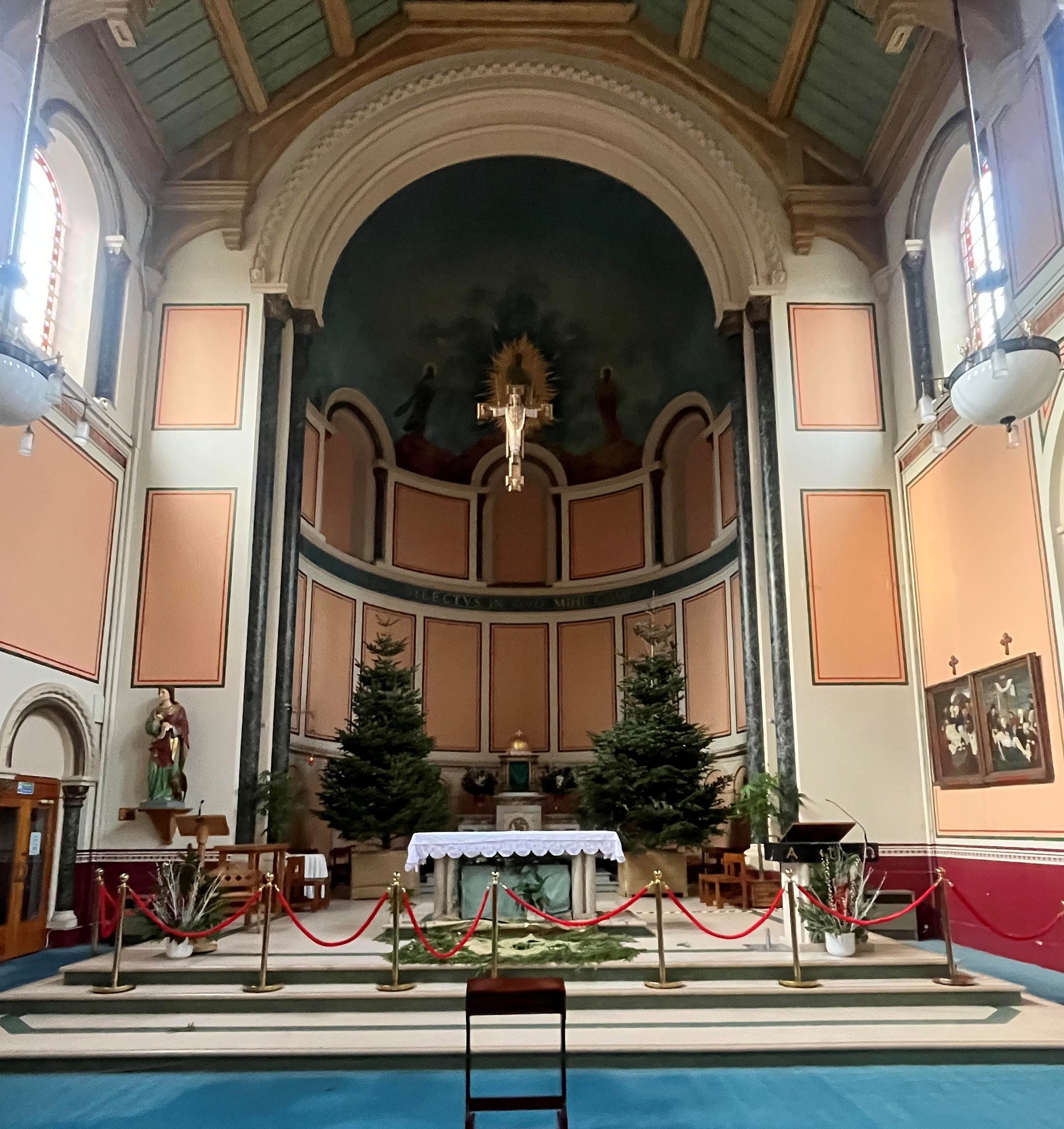
In the post-war period, the formerly lead-covered spires were re-covered in copper. At some point the Armitage paintings in the sanctuary apse were covered over or destroyed, and in 1962 the Aglio painting in the semi-dome of the apse was replaced with a new painting of the Transfiguration by Bartlett & Purnell. In 1963 the organ was rebuilt by Walkers, reusing some of the old pipework, but now located in the west gallery. In 1969, Scott & Jaques prepared plans for reordering of the church, a meeting room in the Blessed Sacrament Chapel and a new sacristy, but these were not taken forward (the current forward altar was installed as part of a 1973 reordering, when the 1860s high altar was dismantled and the communion rails removed). In 1977-8, the crypt was excavated under the direction of Joan Davis to create a youth club. In 2004-06 the nave and sanctuary were redecorated, rewired and a new lighting scheme installed (by Lighting Interiors). In 2010, the paint schemes in the Lady Chapel and St Francis Chapel were restored by IFACS. In 2011 the Walker organ was restored by Keith Bance of Harrow.
Description
The church faces west. The following description follows conventional liturgical orientation (unlike the list description, below).
The list description describes the church building but none of the furnishings and fittings. It can be augmented as above and as follows:
Entry amended and new photos by Elena Curti added by AHP 01.03.2026, incorporating further information from The Tablet and Colin Surtees.
List descriptions:
Church
II
Roman Catholic church. 1841-43 by Joseph John Scoles, the towers slightly later, with a new roof of c.1901, and the interior re-ordered in 1964 and 1973. Red brick set in Flemish bond to Duncan Terrace, yellow brick behind, stone dressings, roof of Welsh slate and lead. Nave, apsidal chancel, and side chapels in the place of aisles, all under a single roof. Neo-Romanesque in style. Principal gabled front to the east, flanked by towers. Central, round-arched, portal with two Caernarvon-arched doorways; three round-arched windows at gallery level with sill- and springing-bands; wheel window in the gable. The south tower is divided into three stages, the first and second flanked by engaged columns; the first stage has a single round-arched portal with Caernarvon-arched doorway; the second stage has two round-arched windows one above the other; the third, belfry stage stands detached above the body of the building, with round-arched openings flanked by brick pilasters, and eaves cornice of oversailing brick, to each side; pyramidal roof of lead. The north tower follows the same design except that it is higher, having a short third stage of blank brick arcading, and then a fourth, belfry stage with two round-arched openings and eaves cornice in the form of machicolated brickwork; broach spire of lead. The simple interior continues the Neo-Romanesque theme with round arches with engaged columns and stiff-leaf capitals between the nave and side chapels, and between the nave and the apsidal chancel, and a similar arcade to the clerestory; later roof of hammer beam construction. (Historians’ file, English Heritage London Division).
Listing NGR: TQ3164983385
Presbytery (39 Duncan Terrace)
II
Terraced houses. c.1841. Built by William Watkins. Yellow brick set in Flemish bond, stucco, roof obscured by parapet. Four storeys over basement, two windows each. The houses form a symmetrical group with the two end houses slightly recessed. Basement and ground floor stuccoed, the ground floor decorated with banded rustication. Steps up to round-arched entrance, the doorcase having reeded pilasters (except to no 39), cornice with fanlight, and decorative glazing to nos 34-35, 37 and 39; panelled doors of original design except to no 39. First- and second-floor windows flat-arched with gauged brick heads, continuous bracketed balcony with iron railings to first floor and window guards to second floor; cornice with blocking course at sill level of third-floor windows which are round-arched with gauged brick heads; parapet. Sashes of original design, with arched glazing bars to ground floor, except to nos 34 (third floor), 37 (ground floor), 38 (third floor) and 39. No 36 rebuilt. Cast-iron railings to area. (Historians’ file, English Heritage London Division).
Listing NGR: TQ3165383358
Convent (40 Duncan Terrace)
II
Terraced houses. c.1841. Yellow brick set in Flemish bond, stucco, roof obscured by parapet. Four storeys over basement, two windows each. The houses form a symmetrical group, with the end houses slightly recessed. Basement and ground floor stuccoed, the ground floor decorated with banded rustication. Round-arched entrance with pilaster jambs, cornice and fanlight. Ground-floor window round-arched; first- and second-floor windows flat-arched with gauged brick heads; continuous bracketed balcony with iron railings to first floor, window guards to second floor. Moulded stucco cornice with blocking course at the sill level of the third floor windows which are round-arched with gauged brick heads; parapet. Sashes of original design, with radiating glazing bars to ground floor, except for nos 40 (first floor) and 44 (ground floor). Cast-iron railings to area.
Listing NGR: TQ3166683405
Architect: J. J. Scoles; G. Goldie; F.W. Tasker
Original Date: 1841
Conservation Area: Yes
Listed Grade: Grade II