Tamworth Road, Long Eaton, Derbyshire NG10
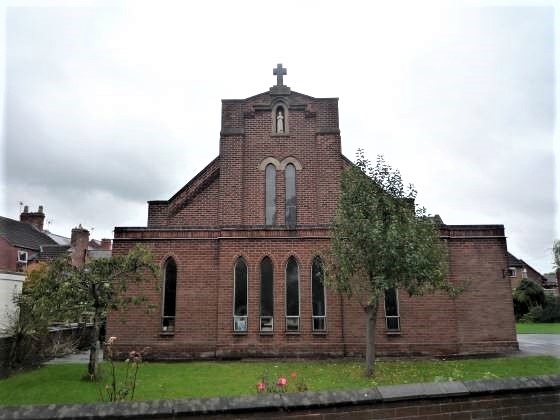
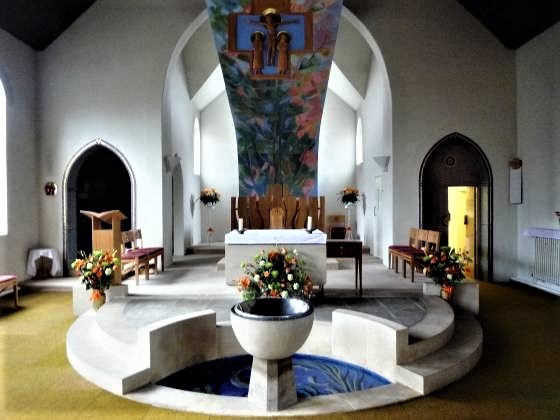
One of a number of interwar churches in the midlands and northwest by J.S. Brocklesby, this is a lancet Gothic design in brick, less architecturally ambitious than some of his later churches. It was made more noteworthy by a dramatic reordering of 1995, with curved sanctuary dais, axially placed font with sunken pool and furnishings of a high order.
In 1884 the Rev. P.F. Elkins of St Barnabas Cathedral was given charge of a new mission in Long Eaton. A site was acquired in Sawley Road (now Tamworth Road) and an iron church seating 76 was built at a cost of £130. A presbytery was built in 1923 from designs by J.S. Brocklesby, and on 13 June 1929 the foundation stone was laid for the present church, also by Brocklesby, which was completed in the spring of 1930. The builders were Atkin and Barton of Shepshed. The Long Eaton Advertiser described the new church as ‘a new sanctuary of simple but tasteful design, approximately 90ft by 32ft in area, with room for 350-500 worshippers, with interior woodwork of Columbian pine’. The papal arms over the altar and two stained glass windows (St Winefride and St Patrick) in the sanctuary were given by Mrs Winifrid E. Cobb, and a baldacchino over the high altar was built by two unemployed parishioners. The cost of the new church was approximately £2,500.
In 1973-4 a narthex addition was built at the west end of the church. At the same time alterations were made to the presbytery and sacristies, and a parish hall built at the rear. The architects for this work were Reynolds & Scott. In 1995 a major reordering of the interior was carried out under the direction of Tim Gough of Austin Winkley Associates (contractors Baggeley and Jenkins of Mansfield).
Description
The church is a red brick lancet Gothic design, with stone dressings and a slate roof. It consists of an aisleless nave and sanctuary, with a later western narthex. The presbytery is attached to the south side of the church. The main west front has a raised frontispiece with paired lancets and a niche below the stepped parapet, containing a statue of St Francis. In front of this, the narthex of 1973-4 is built of matching brickwork, has tall lancet windows, and a flat roof hidden behind a parapet. The entrance to the narthex is on the south side. On the flank walls the bay divisions are marked by attached buttresses, and there are paired lancet windows with stone arches in each bay. The attached presbytery is in domestic style, stone rather than brick faced and with a steep slate roof. It was altered and extended in 1973-4.
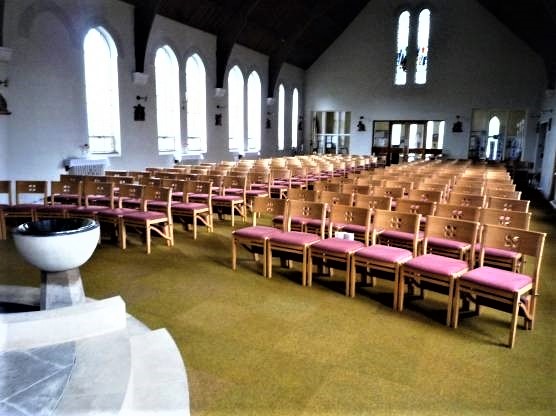
The church interior consists of an aisleless nave with a narrower chancel separated by a pointed chancel arch with narrower arched openings on either side. The walls are plastered and painted, with an arch braced roof of Columbian pine. Apart from the old font, which is now used as a holy water stoup in the narthex area, the furnishings date almost entirely from Austin Winkley Associates’ reordering of 1995. This was a collaborative exercise, involving several artists of note. Features include:
The stained glass figures of St Winefride and St Patrick in the lancets at the west end date from c1930 and were moved here from the sanctuary in 1995. The seating consists of moveable chairs rather than benches.
Entry amended by AHP 29.01.2026
Architect: J.S. Brocklesby
Original Date: 1929
Conservation Area: No
Listed Grade: Not Listed