Horn’s Cross between Northiam and Brede East Sussex
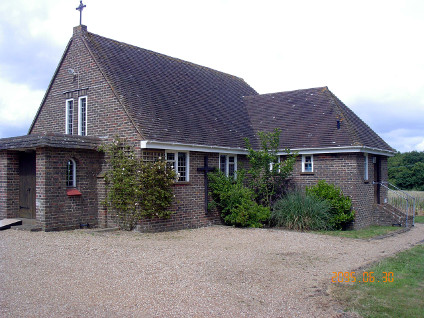
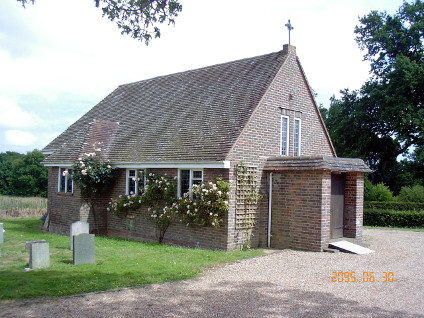
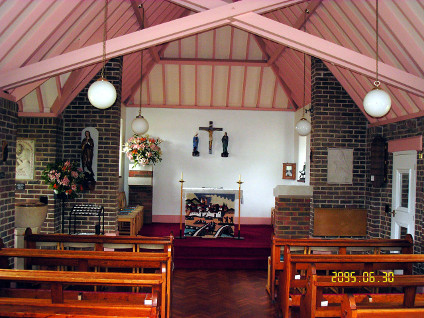
A simple and attractive building in a beautiful rural location, built on land given by the novelist Sheila Kaye-Smith and notable for a fine Joseph Cribb stone-carved relief.
In 1929 the writer and historian Sheila Kaye-Smith and her husband, the Revd Theodore Penrose Fry, an Anglo-Catholic clergyman, converted to Catholicism. In 1930 they acquired Little Doucegrove, an old oast house at Northiam, where they set up a small oratory in the stables. Services were attended by local Catholics and in due course growing numbers made a larger building necessary. Sheila Kaye-Smith (Mrs Penrose Fry) acquired a site at Northiam crossroads and provided funds for the present church, a simple building of local tile and brick seating 60, which opened in December 1935. The architect was Charles Callow ARIBA of Callow & Callow, Hastings and the builder J. Perigoe & Son of Northiam (Sussex Express, 13 December 1935). Some furnishings were brought over from the old oratory. The burial ground was consecrated in 1937. Sheila Kaye-Smith died in 1956 and is buried here.
The church contains carved stone relief by Joseph Cribb, brought from the chapel of St Joseph and St Dominic on Ditchling Common. In 1913, the 31-year-old Eric Gill, received into the Catholic church earlier that year, with his wife Mary and three daughters brought a house and land at the south end of Ditchling Common with the intention of being as self-sufficient as possible and to be in harmony with nature and God. The house was called Hopkins Crank. Together with Hilary and Clare Pepler they purchased land in 1919 adjacent to Folders Lane and began building workshops and cottages. Joseph Cribb joined the community on release from the army. In 1921 the Guild of St Joseph & St Dominic was formed and a chapel was built. This and the other community buildings were demolished after sale of the land in the late 1980s. Either side of the chapel altar had been relief panels by Cribb, the one on the right being that now at Northiam.
Entry amended by AHP 24 October 2026
Architect: Callow & Callow
Original Date: 1935
Conservation Area: Yes
Listed Grade: Not Listed