Gorsey Bank, Water Lane, Wirksworth, Derbyshire DE4
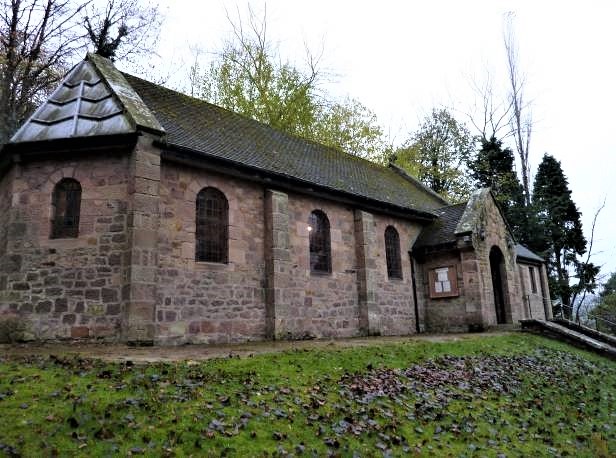
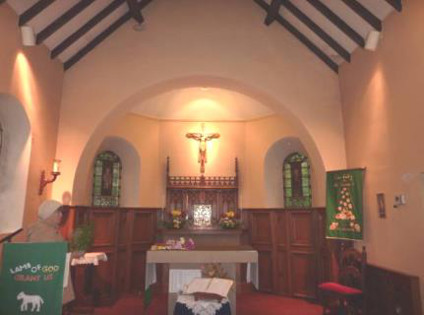
A modest building built of local stone in a low-key but dignified Norman style. An extension has been carefully designed to blend with the original building. The interior has character and incorporates good stained glass. Church and churchyard make a positive contribution to the character of the conservation area.
Wirksworth is a small market town in the Derbyshire Peak District, with a parish church which probably has Anglo-Saxon origins. The area has a long history of lead mining, and cotton manufacture started in the late eighteenth century and the place became an industrial centre during the nineteenth and early twentieth centuries. The church of Our Lady and St Theresa of Lisieux was built as a chapel-of-ease to Matlock and was opened on 29 October 1931. It was built by Fr Charles Cossins (The Tablet 10 June 1939), who had previously built the church of St Augustine, Nottingham (qv). There his architect was J.S. Brocklesby, and although he was sacked after a dispute about costs, and although Brocklesby received no further church commissions after he left his wife for another woman in 1930, the association with Fr Cossins and a general similarity with Brocklesby’s church at Belper (1919) suggests that he may have had a hand in the Wirksworth design.
In 1976 the sanctuary was reordered by Smith & Roper of Bakewell. The same architects added an extension at the west end in matching style in 1986.
Description
A low, small church built of roughly coursed local gritstone rubble. It has a slate roof and leaded apse roof. The church has a canted apse and gabled southwest porch. Window openings are round-arched. A west end extension was added during the late 1990s using matching materials. The interior has at the east end a plain sanctuary arch, at the other a flat-headed opening to the extension with retractable doors allowing the spaces to be thrown together. There is an open timber roof rising from stone corbels. Simple furnishings include bench seating and a Gothic style traceried reredos. There is a simple forward altar. A stained glass scheme of 1931 comprises panels set into plain glass with well-executed figures of saints against a coloured ground.
Text amended by AHP 29.01.2026
Architect: J. S. Brocklesby (unconfirmed)
Original Date: 1931
Conservation Area: Yes
Listed Grade: Not Listed